

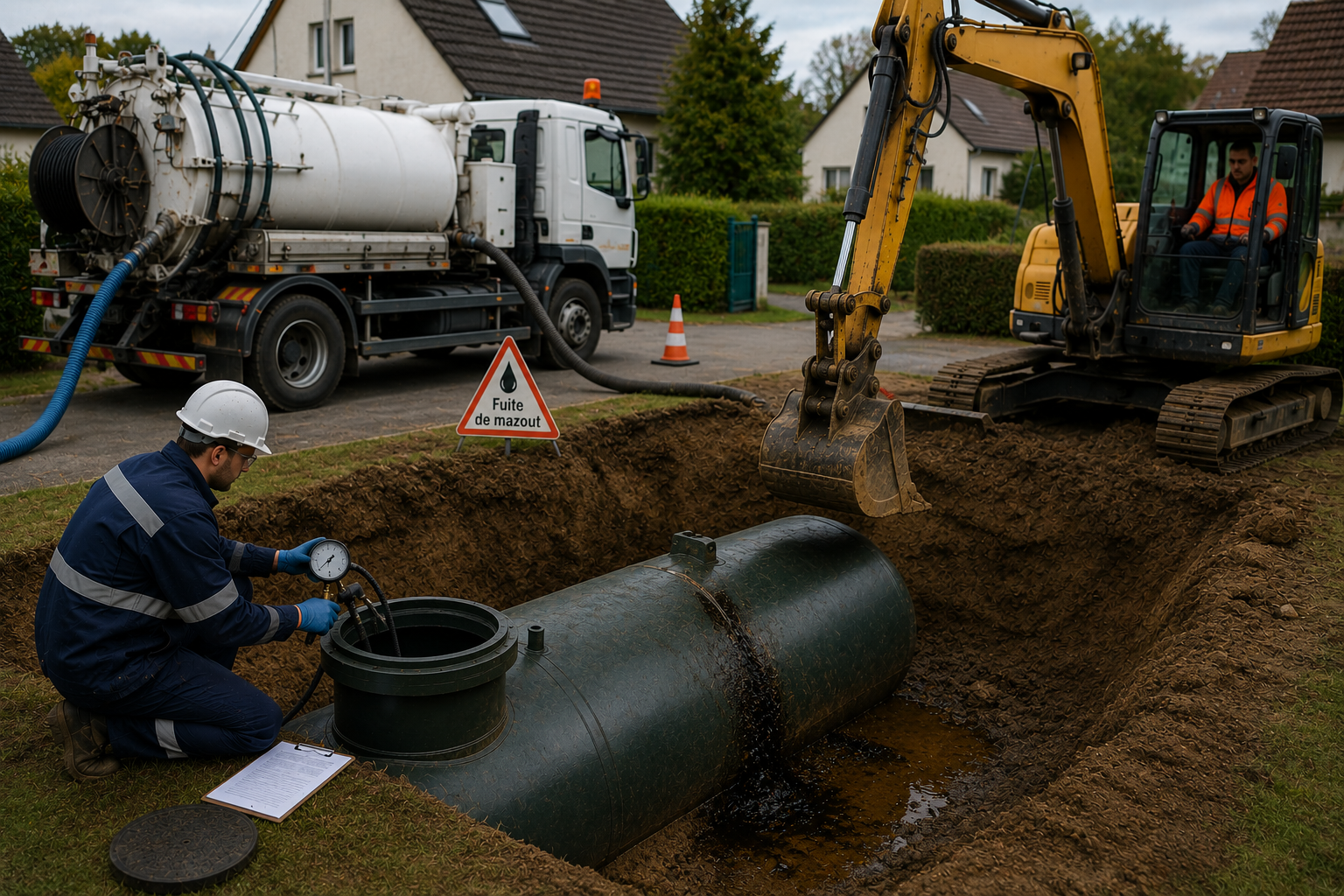
Heating Oil Tank in Wallonia: Regulations, Inspections and Legal Requirements Before Selling or Renting a Property
Practical Guide
Heating Oil Tanks in Walloon Brabant: What Every Property Owner Should Know Before Selling or Renting
A heating oil tank is not something you can simply sell, rent out or forget about without a second thought. In Wallonia, the regulations are clear — and the consequences of neglect can be significant, both for sellers and landlords.
At Génération Immo, we assist property owners every day with the sale of their homes in Walloon Brabant. And we can tell you this: heating oil tanks regularly come back into the discussion — often at the worst possible moment because they were not anticipated in advance. This article is here to help you avoid that.
1. Above-Ground or Underground: A Difference That Matters
The first thing to know is that your tank is either:
Above-Ground
The tank is visible — in your basement, garage, garden or in a non-backfilled pit. It is accessible and can be inspected from all sides.
Underground
The tank is buried in the ground or in a backfilled pit. It cannot be seen. And that is exactly where complications often begin.
Why is this distinction important? Because the obligations regarding inspections, decommissioning and neutralization are not the same depending on the type of installation.
An above-ground tank that is no longer in service must be physically removed and disposed of. An underground tank may either be removed or neutralized in place — but in both cases, the procedure is strictly regulated.
2. The 3,000-Liter Rule — and the Crucial Issue of Total Capacity
In Wallonia, the legal framework is defined by the Walloon Government Decree of July 17, 2003. The key threshold to remember is 3,000 liters.
Here is how the rules apply:
- Less than 3,000 liters: no legal inspection obligation (except in drinking water protection zones). Still strongly recommended.
- From 3,000 to 24,999 liters: Class 3 installation. Mandatory declaration to the municipality + periodic inspections by an approved technician.
- 25,000 liters and above: environmental permit required.
⚠️ A frequently misunderstood point: it is the total storage capacity on the property that matters, not the size of a single tank. If you have two 2,000-liter tanks, your total capacity is 4,000 liters, meaning you fall into Class 3 even though each individual tank is below the threshold.
Another important point: if you cannot prove the actual capacity of your tank (purchase invoice, full delivery invoice, calibration result, etc.), the technician will automatically assume that the tank exceeds 3,000 liters and apply the Class 3 regulations.
3. Inspections and Compliance Labels: Green, Orange or Red
A Class 3 tank must be inspected periodically by an approved technician. The frequency depends on the type of tank and its age:
- Every 10 years: double-wall tanks equipped with permanent leak detection systems, or single-wall tanks placed inside a watertight containment basin.
- Every 3 years: existing single-wall tanks installed before November 29, 2003, whether above-ground or underground, as well as above-ground tanks without a watertight containment basin. This also applies to tanks whose age cannot be proven.
The Specific Case of Above-Ground Tanks: Containment and Accessibility
For above-ground tanks (in a basement, garage or outdoors), the inspection is primarily a visual inspection carried out by an approved technician — provided all sides of the tank remain accessible.
And this is where the technical aspect becomes very concrete: the technician must be able to walk completely around the tank. If the tank is wedged into a corner, placed against a wall or partially obstructed, the visual inspection cannot be carried out properly. As a result, the installation may be considered non-compliant.
A second technical obligation applies to above-ground tanks of 3,000 liters and more: double protection. For installations placed after August 24, 2008, this is mandatory.
In practice, this means either:
- A double-wall tank equipped with permanent leak detection;
- Or a single-wall tank installed inside a hydrocarbon-proof containment basin.
This containment basin must be correctly sized, generally with a capacity equal to at least 110% of the tank’s volume.
📌 For installations dating from before August 24, 2008, above-ground tanks without a containment basin are still tolerated, but they remain subject to a mandatory visual inspection every 3 years by an approved technician.
Overflow Prevention System: Mandatory, Not Optional
Any tank with a capacity of 3,000 liters or more must be equipped with an overflow prevention system. This is not a recommendation — it is a legal obligation.
Two systems are officially recognized:
- The whistle system (acoustic probe): the most common solution. A tube inside the tank emits an audible whistle when the oil reaches approximately 95% capacity.
- The electronic probe: a more modern system that automatically stops filling at 95% capacity.
⚠️ No whistle system = guaranteed orange label during inspection.
At the end of the inspection, the technician applies a compliance label:
- Green: fully compliant.
- Orange: compliance work required within 6 months.
- Red: tank decommissioned — no further oil deliveries allowed.
4. Selling Your Property? What You Absolutely Need to Anticipate
This is the core issue for us as real estate professionals. A heating oil tank is part of the sales process and needs to be properly managed — provided it is anticipated in time.
The Tightness Test Before the Sale
When a property has an underground heating oil tank of 3,000 liters or more, it is strongly recommended to anticipate the issue of the leak tightness test before putting the property on the market.
In practice, notaries and buyers very frequently request the tank’s inspection and compliance documents in order to secure the transaction and avoid any future environmental risks. When the latest inspection is outdated, missing or incomplete, a leak tightness test may be requested before the signing of the final deed.
In many sale agreements in Wallonia, a clause is therefore included to specify:
who bears the cost of the inspection;
what happens in the event of non-compliance;
and who is responsible for any required remediation or compliance work.
At Génération Immo, we recommend carrying out this test before putting the property on the market — or even before the first visits — in order to avoid the risk of the buyer withdrawing, the transaction being blocked or the sale price being renegotiated during the process.
Nothing is worse than finding a buyer, signing a sales agreement, and then receiving a non-compliant inspection certificate just before the final deed. This is often the most difficult situation: beyond the costs of compliance work or tank neutralization, concerns then arise regarding possible soil contamination, environmental liability and the legal consequences that may result from it.
Transfer of the Class 3 Declaration: The Trap to Avoid
This is THE point many sellers forget — and it can create extremely problematic situations.
When you sell your property, the Class 3 declaration registered in your name must be transferred to the buyer. This transfer must take place no later than the signing of the sales agreement and, in any case, before the final notarial deed.
In practice, there are two possibilities:
- The buyer signs the transfer documents directly;
- Or you authorize someone — your real estate agent or notary — to handle the transfer on your behalf.
🚨 If this transfer is not completed, you officially remain the operator of the tank even though you no longer own the property.
Real-Life Example
A seller from Wavre sold his house in September. In April of the following year, the new owner discovered a leak in the underground oil tank. The Class 3 declaration had never been transferred.
The Walloon administration turned to the original seller — still officially registered as the operator — for the soil remediation costs.
5. Renting Your Property? The Landlord’s Obligations
Many landlords believe the heating oil tank is the tenant’s responsibility. That is incorrect.
In Wallonia, inspection and compliance obligations related to the tank remain the responsibility of the property owner — not the tenant.
In practice, this means:
- You must ensure the tank is compliant before renting the property.
- You remain responsible for renewing inspections throughout the duration of the lease.
- If the tank leaks or is out of service, you must act quickly.
6. Tanks No Longer in Use: Neutralization Is Mandatory
Have you replaced your oil heating system with a heat pump, natural gas or pellet boiler? Good decision — but the old tank cannot simply remain unused.
In Wallonia, any tank taken out of service must be officially neutralized according to a regulated procedure.
Why Is This Mandatory?
- To avoid soil and groundwater pollution;
- To avoid ground collapses or subsidence caused by abandoned underground tanks.
How Does the Process Work?
Step 1 — Emptying, Cleaning and Degassing
An approved company empties the tank, removes sludge and residues, cleans the interior and completely degasses the tank.
Step 2 — Filling With Inert Material
The tank is then filled with an inert material, most commonly polyurethane foam or sand.
At the end of the process, you receive an official neutralization certificate that must be carefully kept. This document will be requested during a future sale.
📌 For above-ground tanks, neutralization is generally not accepted: they must be physically removed and disposed of.
7. What Génération Immo Does for You
As part of our sales mission, we systematically:
- Check the type of tank, its capacity and existing documentation;
- Verify inspection dates and compliance labels;
- Inform you clearly about your legal obligations;
- Coordinate the transfer of the Class 3 declaration;
- Direct you to approved technicians if necessary;
- Ensure all documents are ready for the notary.
Our goal: to make sure the heating oil tank never becomes an obstacle to your property sale.
Frequently Asked Questions
My tank contains less than 3,000 liters. Do I still need to do something when selling?
Legally, inspections are not mandatory below this threshold (except in water protection zones), but buyers and notaries may still request them. Abandoned underground tanks must still be neutralized or removed.
I have two 2,000-liter tanks. Do I need a Class 3 declaration?
Yes. The total storage capacity counts: 2 × 2,000 L = 4,000 L.
Who pays for the inspection during a sale?
In principle, the seller.
I stopped using my tank 5 years ago. Do I still need to neutralize it?
Yes, absolutely.
What happens if I sell without transferring the Class 3 declaration?
You remain officially registered as the tank operator and may still be held liable in the event of leaks, pollution or administrative controls.
Disclaimer : The information contained in this article is provided for general informational purposes only and does not constitute legal, technical or administrative advice. Regulations applicable to heating oil tanks in the Walloon Region may change at any time. Despite the care taken in drafting this article, Génération Immo cannot be held liable for any errors, inaccuracies or omissions, nor for any consequences resulting from the use of this information. For any specific situation, we recommend consulting an approved technician recognized by the Walloon Region, your notary or any other qualified professional.